A bundle of human hair can look beautiful in your hand and still become a problem after several washes. It may feel silky. It may shine under salon lighting. You may even run your fingers through it and think the quality is excellent. Then the extensions are installed, washed several times and worn for a few weeks — and suddenly the client starts complaining about tangling, roughness or matting.
One possible reason is something many buyers never check: reversed hairs inside the bundle. In professional extension work, you may hear them described as flipped hairs, reversed hairs or hairs placed in the wrong root-to-tip direction. This detail matters because human hair has a directional outer structure. Proper Remy hair is generally defined by strands being maintained in a consistent root-to-tip direction, rather than mixed randomly. Understanding this before you buy can save you from difficult installations, unhappy clients and hair that looks premium only until its first few washes.
What Are Reversed or “Flipped” Hairs?
Originally, every strand has a root side and a tip side.
If the hair is carefully collected and kept in its natural direction during sorting and production, the root ends stay together and the tips stay together. This is the basic principle behind cuticle-aligned Remy hair.
But if loose hair from different sources is mixed, dropped, re-sorted incorrectly or processed without maintaining direction, some strands can end up reversed:
root → tip
next to
tip → root
That is what we mean by reversed or flipped hairs.
Reversed Hair vs Naturally Shorter Hair
Do not confuse reversed hairs with short hairs inside a bundle. Natural ponytails normally contain hairs of different lengths because every strand on a person’s head is at a different stage of growth.
A shorter strand is not automatically defective. The important question is which direction it is facing. This is why professionals evaluate much more than whether a bundle contains short hairs.
Why Reversed Hairs Can Cause Tangling
One or two reversed strands will not necessarily destroy an entire bundle. The real problem begins when a significant amount of hair is mixed in opposite directions. When extensions move during everyday wear, thousands of strands repeatedly rub against one another. Think about how much movement extensions experience:
- brushing;
- washing;
- blow-drying;
- sleeping;
- styling;
- wearing scarves and jackets;
- exercising;
- moving the head throughout the day.
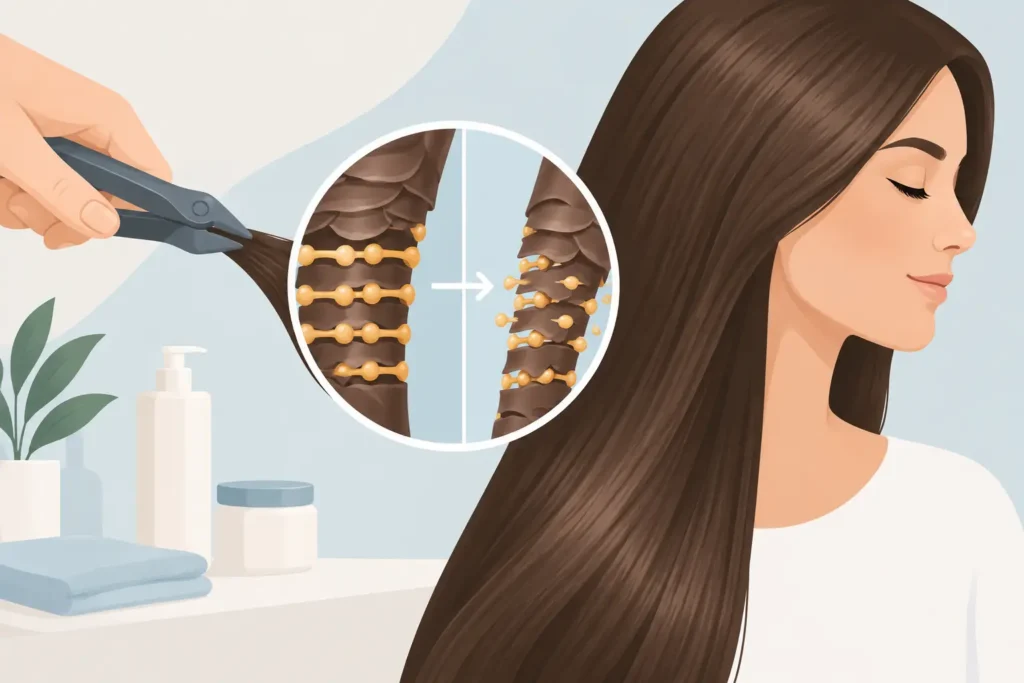
When the cuticles of neighboring hairs face opposing directions, the surfaces can catch against each other more easily.
What happens when opposite cuticle directions meet
Professional descriptions of Remy hair consistently emphasize maintaining a single root-to-tip orientation. When hairs are mixed root-to-tip and tip-to-root, the directional cuticle surfaces oppose each other. Industry sources describe this as one of the key structural differences between properly aligned Remy hair and mixed-direction non-Remy hair. This is especially noticeable in longer hair. The longer the extensions, the more surface area there is for strands to interact. That is why a quality problem that seems insignificant in a short sample can become much more obvious in long extensions during everyday wear.
Why the problem may appear only after washing
Low-quality hair can feel extremely soft when you first open the package. That does not automatically tell you how the hair will behave after repeated washing. Some heavily processed hair can be treated or coated to improve its initial feel. Once the surface treatment gradually changes through washing and wear, the underlying quality becomes easier to evaluate.
Remy Hair and Cuticle Alignment: What Is the Difference?
The word Remy is frequently misunderstood. It does not describe a color, country of origin, texture or extension method. Traditionally, Remy refers to human hair kept in a consistent root-to-tip orientation so the cuticles remain aligned. That means:
Remy = direction and cuticle alignment
It does not automatically mean:
- virgin;
- Russian;
- Slavic;
- uncolored;
- double drawn;
- single donor;
- the highest possible grade.
These describe different characteristics. A supplier can therefore call hair “human hair” without telling you anything useful about its directional alignment. And this distinction matters. If the hair is intended for professional extensions, the way strands interact over months of wear is far more important than the marketing label printed on the package.
How to Check a Hair Bundle Before Buying
1. Check the direction of the hair
A properly prepared bundle should have a clear, consistent direction.
If you are buying loose bulk hair or a ponytail, ask the supplier directly:
- Is the original root-to-tip direction preserved?
- Is the hair Remy?
- Is the cuticle intact?
- Has the hair been re-sorted?
- Is it collected as ponytail hair or assembled from mixed loose hair?
2. Perform a gentle finger test
A common practical test is to take a small section and gently slide your fingers along the strand in both directions.Going from the root side toward the tips should generally feel smoother. Moving in the opposite direction may produce slightly more resistance because you are moving against the cuticle direction. A professional supplier describes this directional touch test as one way of checking for an intact directional cuticle.
However, treat this as an indicator, not laboratory proof. Highly processed hair may behave differently, and surface products can affect what you feel.
3. Ask about sourcing and processing
This is one of the most important checks and one of the most frequently skipped. You cannot reliably evaluate the entire history of a hair bundle simply by looking at it. Ask the supplier how the hair was collected, sorted and processed. A supplier who controls more stages of production can usually tell you far more about the material than a reseller who receives an already finished anonymous product.
Choosing Hair From NICEHAIR
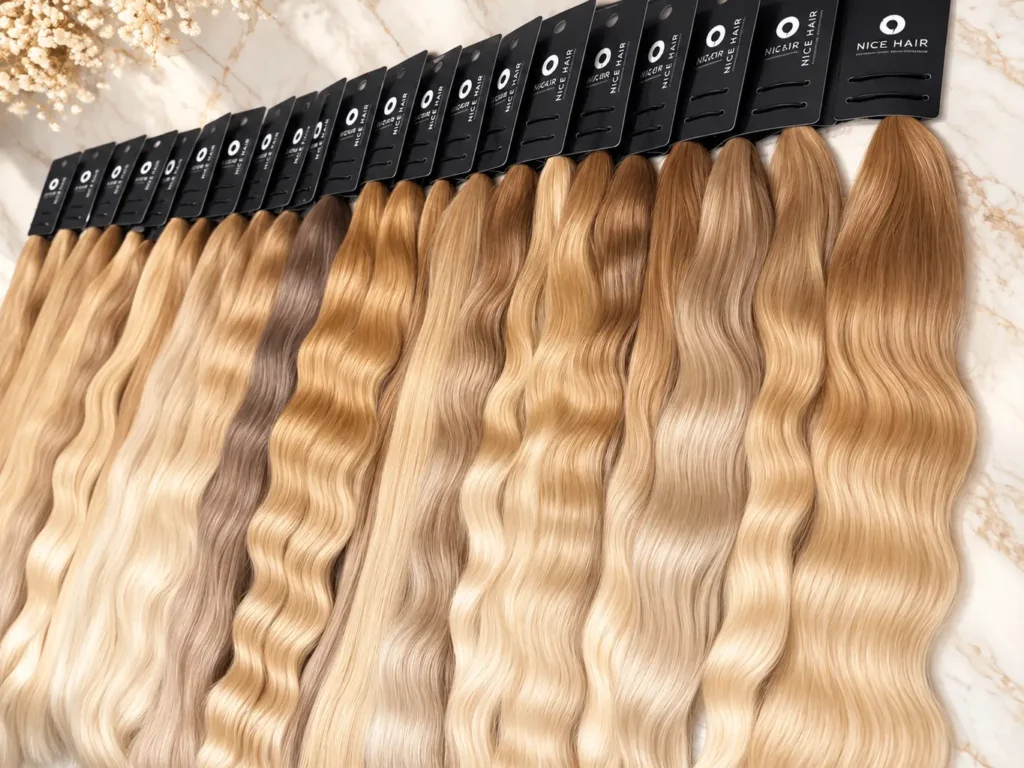
We have more than 14 years of experience in the hair-extension field and operate our own production process. Our range focuses on premium Slavic human hair, with quality control from sourcing through the finished product. This matters because professional stylists need more than attractive hair on the day it arrives. They need hair they can confidently select for real clients, real installations and repeated wear.
The goal is not simply to buy hair that looks beautiful in a bundle. Choose hair that is selected to perform after it leaves the bundle.

Certified hair extension stylists with 14+ years of experience. Own production of virgin Slavic hair, 10,000+ bundles in stock, salon in Dubai. Specialization: keratin extensions, ethical sourcing Russia & CIS, cold color technology.